How much does it cost a small business to build a website in 2026?
What a small business website really costs in 2026, to build and to keep running, and why we think AI has changed what you should be paying for one.
On this page+
If you run a small business, a website costs a few thousand dollars to have built properly, a lot less up front if you build it yourself, and a good deal more over the years if it's built the way most sites still are. GruffyGoat publishes $1,500 to $8,000 for freelance work, and building it yourself on a platform has no build price at all, just a subscription from about $16 a month.
Here's what we think, though. AI has changed how websites get built, and most small businesses are still paying for them the old way. In experienced hands it takes the slow, expensive parts out of a custom build, so a site made properly for your business now costs a few thousand and takes weeks. Without the experience it turns out something generic that doesn't quite work. And the build was never the biggest cost anyway. The upkeep is, and most of it has quietly stopped being necessary.
We build websites for a living, so we're not neutral. Every figure is attributed, so you can see whose number it is and decide what to make of it.
How much does it cost a small business to build a website?
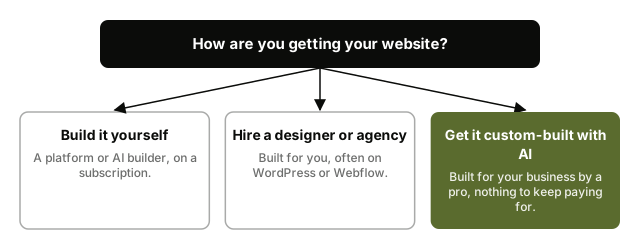
Anywhere from nothing to $35,000 or more, and that range isn't vagueness. "Getting a website" covers three quite different things you can do, and which one you pick decides most of what you'll pay for years afterwards.
Building it yourself on Squarespace, Wix or Webflow
Wix, Squarespace and Webflow rent you everything at once: the tools to build the site and the hosting it runs on afterwards. You pay monthly and you do the building. Squarespace runs from $16 to $99 a month on an annual plan, Wix from $17.77 to $159.77, and Webflow from $15 to $25. WordPress.com is the same arrangement from the company behind WordPress, at $4 to $45 a month. AI site builders sit in the same bracket, and so does asking an AI chat tool to write you a site from scratch.
WordPress is free software that anyone can install on a server they rent. WordPress.com is a company that installs it and runs it for you. It's the difference between owning a house and renting a flat: own it and you can knock through any wall you like, but the boiler is yours to fix.
The build price is your evenings, and the risk is the result. A ready-made theme leaves your site looking like every other business that picked it, and no tool will tell you what your homepage ought to say or what makes a customer pick up the phone. Designing a website is a separate trade. Nobody is good at a trade they've never worked in, and you already have one that takes all week. That isn't a slight on business owners. It's the reason the job exists.
How much does it cost to hire a website designer or agency?
This is what most people picture: you hire someone, they build it, and you get on with running the business. Freelancers and agencies build on all sorts of platforms and technologies. WordPress and Webflow are popular choices, largely because both come with a content management system, or CMS, which is an editor that lets you update your own pages and posts once the site is handed over.
GruffyGoat publishes $1,500 to $8,000 for freelance work and $6,000 to $35,000 or more for a boutique agency, and Clutch puts the hourly rates behind those figures at $100 to $149 in the US and well under that in most other countries. Those numbers are fair for the way the work is done. It's skilled time, priced as time. Where it gets expensive is afterwards. A WordPress site runs on plugins, small add-on programs that give it features it didn't come with, and a site assembled from plugins needs looking after for as long as it exists. That bill has nothing to do with how good the people who built it were.
How much does a custom website cost?
Around $2,000 to $7,000 for a site custom-built with AI, depending on how many pages you need. That's what we do at Mintygo, and our current prices are on our pricing section. As with hiring a designer, you're paying someone to build it for you. What's different is how it gets made and what you're left with afterwards.
We've built websites the long way for years, and we now use AI to do the slow parts in a fraction of the time. The judgement stays with us: what your site needs to say, who it has to reach, how it gets found. What comes out is aimed squarely at the problems most small business owners have with the site they've already got.
- It's quick. We build every site to score 98 or more on Google's own speed test, and you can run that test on ours.
- There's nothing to keep paying for. It isn't built on plugins, so there's no care plan and no renewals, nothing to break after an update and nothing for anyone to break into.
- It's made for your business, rather than dressed up from a template, and built to be found in your area from the start.
- It's yours, and you can still change it. You own it, and you add pages and blog posts yourself through a plain editor.
- It's live in weeks, on a date we commit to, with 20% back if we miss it.
Should you use AI to build your own website?
You can, but for most small businesses it's the wrong place to save money. AI really has changed how websites get built, and it's genuinely good at a lot of the work. Ask for a website and you'll have something that looks like one within the hour.
What it can't give you is the knowledge of what a small business site actually has to do. It doesn't know what your homepage needs to say in the few seconds before someone decides to leave, how people in your area search for what you sell, what makes a visitor ring rather than scroll on, or what happens the first time you need to change something. So it fills every gap with something plausible. That's where AI slop comes from: sites that look finished and say nothing in particular, that look like every other site the same tool has made, or that fail in ways you won't spot straight away, like a contact form that never sends or pages Google can't make much sense of.
None of that is a reason to be frightened of AI. It's a reason to be clear about what it amplifies. In our experience, the difference between a good AI-assisted site and a bad one is almost entirely the experience of the person steering it: knowing which suggestions to keep and which to throw out, what a site for your kind of business has to get right, and how to check it's working. That's the same point as building it yourself, just with a faster tool.
For a quick holding page while you test an idea, it'll do. For the site your business depends on, the same tools in the hands of people who've built websites for years are exactly why a custom build has become quick and affordable, and that's the route we'd point most small businesses towards.
How much does a website cost per month?
A few hundred dollars a month isn't unusual for a small business site, and neither is a few dollars. What separates them is what the site is built on, not how good it is, which makes this the bill that really decides what a website costs you. The build is paid once. The domain, the hosting and the upkeep keep coming for as long as the site is switched on.
How much does a website domain cost?
About $11 a year, and it's the one bill that doesn't care how your site was built. Verisign, the company that runs .com, charges $10.26 a year for one, rising to $10.97 in November 2026, and every seller adds its margin on top. We recommend Porkbun. A .com there is from $11.08 a year, and the renewal stays close to that. Cloudflare sells domains too, and charges what it pays for them with no markup on top. Look out for the renewal price rather than the discounted price you see for the first year, because the renewal is what you'll pay for the life of the business. The padlock in the browser, the SSL certificate, used to be a paid extra too. Most good domain providers now include one for free, so if someone tries to sell you one, ask why.
How much does it cost to host a website?
Anything from free to about $100 a month, depending on whose server your website sits on.
Wix, Squarespace, Webflow and WordPress.com own the servers their customers' sites run on, so hosting is already inside the monthly price. The free WordPress is the odd one out. Anyone can install it, which is why designers reach for it, but free software still has to run on a server somewhere, and renting that server is your bill. On Codeable's figures that's about $25 to $100 a month for a host that also keeps the software patched and backed up, which is the kind most designers point you at.
A site built the way we build them is the cheapest of the lot to host, because every page is ready before anyone asks for it, so the server barely has to think. Cloudflare Pages will host a site like that on its free plan, Netlify starts at $9 a month, and Vercel is $20 a month per person on its Pro plan, with a free plan that's meant for personal projects rather than businesses. Ours is included for the first year, then about $14 a month.
How much does it cost to maintain a website?
On a WordPress site built for you, usually $100 to $300 a month before you've changed a word, which is Codeable's range for most small businesses on a care plan. A care plan keeps the software patched, meaning WordPress itself, every plugin and the theme, along with backups and malware checks. Those jobs exist because the site is assembled from parts other people wrote, and every part gets updates. This is the boiler. Keep on top of it and the site will run happily for years. Leave it a year or two and things quietly stop working, or an out-of-date plugin lets in someone who shouldn't be there.
Then there are the plugins themselves, renewed every year by the companies that make them. Elementor Pro starts at $49 a year, Yoast SEO Premium is EUR 118.80, about $137, and WP Rocket is EUR 49.95, about $58, and most sites run more than three. Then comes a developer's time whenever something needs changing, like a new page or an update that broke the layout. In our experience, once the host, the care plan, the plugins and the odd hour of fixes are added together, plenty of small business WordPress sites cost well over $200 a month to keep. Nobody is hiding that. Each part is billed by a different company, and nobody adds them up for you.
Webflow looks after its own software, so its plan covers most of the upkeep. A site you built yourself still has paid add-ons and all of your own time, and if you installed WordPress yourself, the whole boiler is yours. A site custom-built with AI has no care plan or renewals to pay for, because there's nothing in it that needs patching.
| Cost | Build it yourself | Hire a designer or agency | Get it custom-built with AI |
|---|---|---|---|
| Build | None | $1,500 to $8,000 freelance, $6,000 and up agency | Around $2,000 to $7,000 |
| Domain | About $11 a year | About $11 a year | About $11 a year |
| Hosting | In the subscription, $15 to $99 a month | $25 to $100 a month, managed | Included year one, then about $14 a month |
| Care plan | None on a platform, yours to do if you installed WordPress | $100 to $300 a month on WordPress, far less on Webflow | None |
| Plugins and licences | Paid apps and add-ons, if you use them | From $49 a year each, usually several | None |
| Changes | Your time | $100 to $149 an hour in the US, less elsewhere | Simple changes yourself, or pay us hourly |
| Your own time | High, learning the tool and keeping it from looking like a template | Low | Low |
How much does a small business website cost over three years?
Put the four bills together over three years and the three routes barely overlap. These are ranges rather than forecasts, because nobody can tell you the exact figure for your site, and anyone who quotes one to the dollar is guessing. Three years is long enough for the running costs to show and short enough that it's still the same site.
Build it yourself. There's no build price, just a platform plan at $16 to about $40 a month for what a small business needs, plus two domain renewals once the free first year runs out. That lands somewhere around $600 to $1,450, without counting all the evenings you spent building it or any paid add-ons along the way.
Hire a designer or agency. A freelancer's $1,500 to $8,000 for the build, then the hosting, the care plan, the plugin renewals and a developer's time for as long as the site is up. Over three years that comes to somewhere around $6,000 at the lower end and $15,000 at the higher end, with a busy site on the priciest care plan going past it.
Get it custom-built with AI. Around $2,000 to $7,000 to build, hosting free for the first year and about $14 a month after that, the same domain renewals, and nothing else to maintain. You end up somewhere around $2,400 to $7,400 across the three years.
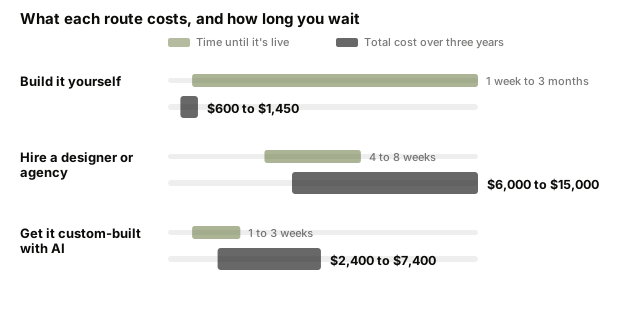
Doing it yourself is far and away the cheapest and far and away the slowest. It takes a week to three months on Bluehost's reckoning, depending on how many evenings you can spare, and you're the designer whether you've ever been one or not. Getting someone in takes four to eight weeks, going by Elementor's timeline for a small business site, and gives you the widest cost range of the three, because the upkeep carries on long after the build is paid for. The third route skips most of the recurring costs and is live in one to three weeks. That's how long our builds take, and we put the launch date in writing.
Does website speed affect your Google ranking?
Yes, and it costs you customers as well, which is the more expensive half. Google says its "core ranking systems look to reward content that provides a good page experience", and that its Core Web Vitals, three measures of how quickly a page becomes usable, are part of how it ranks. It also warns against chasing a perfect score for its own sake, which is fair. The customer half needs no research at all. People leave pages that make them wait, and none of that ever shows up on a bill.
Speed follows from how a site is put together, which makes it one more cost that comes down to what your site is built on. A page that has to be assembled from a database every time someone visits, then load whatever a dozen plugins want loading, has more to do than a page that was ready before anyone arrived. A well-built site on any platform can be quick, but it's why plugin-heavy sites tend to sag as they age.
You needn't take anyone's word for it. PageSpeed Insights is Google's own free test, it works on any address, and it reports both what real visitors experienced and what a lab test measures. Run it on your own site, and on a site built by whoever wants to build your next one. A builder who won't show you a score for their own work has told you something.
How much should a small business pay for a website?
For an ordinary small business site, a few thousand dollars to build and not much more than hosting to keep it running. That's our view, and it's worth saying why prices haven't looked like that until now.
Fifteen years ago a custom site meant a designer, a developer, weeks of back and forth and a five-figure bill, so most small businesses went without or made do. Platforms changed that. WordPress, Wix, Squarespace, Webflow and others gave owners a decent site for a subscription, and gave designers a shared foundation to build on, so the bill came down from tens of thousands to thousands. It was a genuinely good answer, and for plenty of businesses it still is. The trade was upkeep. A site assembled from a database and a pile of add-ons needs those parts kept current, and that's where the care plans, the licence renewals and the developer hours come from. Nobody designed it that way. It was simply the price of getting a good site at all.
AI has changed the first half of that, for the people who know how to use it. A build that used to take weeks of hand work now takes days. Price should follow the time the work takes, so prices across the industry should come down. Ours will too. That's not a discount. It's what the work now takes.
A website should cost what it takes to build well. What it takes has changed.
So here's what we'd tell a small business owner now. If you're testing an idea, a platform is fine, and it's cheap to walk away from. If you need a shop, a members' area or a team of people editing every day, that's work a platform and a good designer do well. For everything else, which is most small business sites, we'd get it custom-built by people who know what they're doing. That's what we sell, which is exactly why every figure above is there for you to check. And if you're already on WordPress and it's the upkeep you're tired of, moving off it without losing your rankings is a job of its own, and we've written up how it's done.
Want a figure for your site?
If you'd like to know what a site custom-built with AI would cost for your business, ask us for a fixed quote. You'll get one price, a launch date, and a clear list of what's in it.
Common questions
Why do website prices vary so much?+
Because "a website" covers very different jobs, from a subscription you set up yourself to weeks of an agency's time. Most of the gap comes down to who builds it, how many pages it needs and what it's built on, and that last one decides what you keep paying after launch. It's why two quotes for the same site can be thousands of dollars apart and both be fair.
How do I know if a website quote is fair?+
Work out what the site will cost over three years, not just the build, and check what's in it - how many pages, who writes the words and finds the photos, whose name the domain is in, and what it needs every month afterwards. For the build itself, GruffyGoat's $1,500 to $8,000 for freelance work is a fair guide. A cheaper build that needs a care plan can end up costing more than a pricier one that doesn't.
Can I get a decent website on a small budget?+
Yes, if you build it yourself. A year on Squarespace or Wix costs a couple of hundred dollars, and an AI builder will get you something up quickly, which is a sensible way to test an idea. What you trade is your time and a site that looks like plenty of others, so once the business depends on it, it's worth paying someone who does this for a living.
How much does a 5 page website cost?+
On a platform it's the price of the subscription, from about $16 a month. Freelancers quote $1,500 to $8,000 for a small business site on GruffyGoat's figures, and the number of pages is one of the biggest things that moves the price. Custom-built with AI it's around $2,000 to $7,000 depending on the number of pages, and our pricing section shows where five pages lands.
Should mobile-friendly design and SEO cost extra?+
A site that works properly on a phone shouldn't be an extra in 2026, because Google looks at the mobile version of your site when it decides where to rank you. The basics of being found locally - proper page titles, a page for each service and a linked Google Business Profile - belong in the build too. Ongoing SEO work, like new posts every month, is a separate job and fairly charged as one.
Do I have to pay for a website all at once?+
Usually not. Designers and agencies commonly split the price, with a deposit up front and the rest at launch or at milestones along the way. We take half up front and half on the day your site goes live.
Do I need a website maintenance plan?+
If your site runs on WordPress, usually yes, because somebody has to keep the software and plugins patched, and it's better done properly than not at all. On Codeable's figures most small businesses pay $100 to $300 a month for one. The better question is whether your site needs one at all, because a site that isn't built on plugins has nothing to patch.
How much does it cost to redesign a small business website?+
It depends on how much of the old site comes with you. A refresh that keeps the content and the structure costs less than a rebuild, and a rebuild costs about the same as a new site of the same size. Ask whether your pages and their addresses move across, because that's usually where redesign prices differ, and it's what protects your place on Google.
Are website prices coming down because of AI?+
They should. AI has cut the time it takes experienced people to build a good site, and price should follow the time the work takes. Not everyone has changed how they work yet, so prices across the industry haven't caught up, but ours are already set that way.